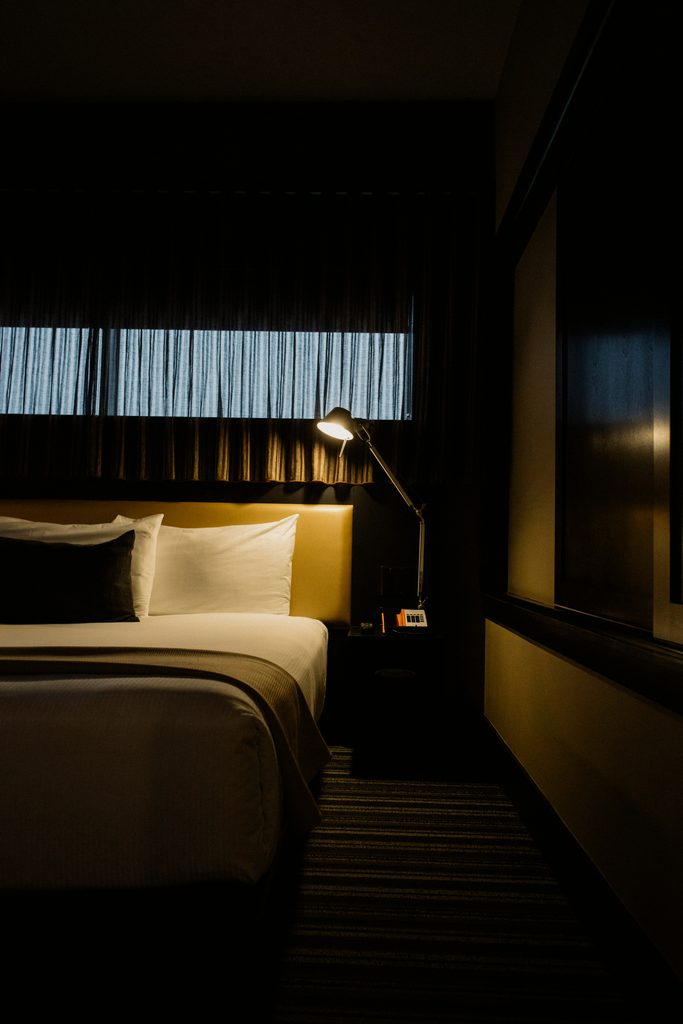
It started when the house along the street blew up. We were told it was safe and I suppose it was. The houses either side of the gap were fine and there was no trace of gas or anything. But that night the tapping started.
First it was on the windows, a light, tap tap tap, like a branch against the panes in a light breeze. Except there were no branches near my window. Just the tap tap tap after dark. It started to unnerve me. There was never any trace when I pulled back the curtains to look and nothing seemed out of place when I looked at the windows from the street in daylight.
Gradually I got used to it and talked about perhaps it was mice or birds in the attic. I even added it to the ghost stories that were exchanged at work - I live in York, after all, and there are always ghost stories. However, as the nights grew longer and the days got cooler, the tapping changed.
It was the day after my birthday, 22nd of September, when I sat bolt upright in bed. The tap tap tap was now coming from the living room. I remember how frozen I felt, pinned to my bed as the gentle tap tap tap seemed to patter against the wooden floor. I crept to the door of my bedroom and listened. There were no human footsteps, no rustle of clothes and no sigh or grunt of someone moving. I opened the door just a crack, peering out into the hall. No light shone from under the living room door. As I gathered my courage to confront the noise, the tap tap tap faded away and I realised it was dawn.
That was three days ago. I forgot about the tapping as I went away for work. I lost myself in the hectic pace of the conference and the after conference drinks, happy to forget about strange noises, but now I was back. There was no sign of any disturbance in the house. Nothing had moved. I had a quick shower and got into bed with Netflix playing loudly as I wriggled down into the bed.
But it didn't drown the tapping. I can hear it now, tap tap tap in the living room. I am lying here, terrified, as the tap tap tap gets nearer and nearer. The tapping is in the hall now and getting closer to my door. I pick up my phone from the bedside cabinet and scroll through my contacts, looking for the number that had been forced on me. Now I was desperate. I found the name - Rev D King, Exorcist. My fingers trembled as I dialled the number, burrowed under the covers. Dawn is two hours away and the tapping is getting closer.
“You can’t be too careful.” Dan said as he nailed another horseshoe on the top door. “The fairies cause problems.”
Yvonne looked critically at the horseshoes. “Shouldn’t they be the other way up?”
Dan looked shocked. “If they are on the other way, all the luck would drain out.”
Yvonne chose her words with care. “Dan, you know that fairies aren’t real, right?”
“How can you be sure?” Dan asked, standing back and looking at his handiwork. “You know that there are a lot of strange things in this world that never make the papers.”
Yvonne nodded. “Absolutely. But have you ever seen a fairy?”
“That’s not the point.” Dan said. “Milk is going missing from the dairy.”
“And that’s nothing to do with the local cats?” Yvonne asked. “What other proof?”
“The iron keeps them away.” Dan said. “It proves that it’s working.”
“Did you ever see a fairy before you put the iron up?” Yvonne asked.
Dan rubbed his sleeve over the latest horseshoe to knock off the dust. “Just because I haven’t seen a fairy, doesn’t mean they aren’t there.”
Yvonne sighed. “You’ve been a vampire here for four hundred and seven years. If there were any fairies around here, I think you would have noticed by now.”
“I told you to stay away from me.” Cana rolled away from him, clutching at her long knife. There was plenty of room in the clearing and the fire was still bright.
“I thought we stayed close when camping in the woods,” Sion said. “To keep warm.”
“It’s past midsummer,” Cana said. “It’s not cold.” She rolled over and looked at the stars peeking through the canopy of leaves overhead. “The fire will keep away wolves, and the horses will warn us if anything approaches. Get some sleep. We should reach the castle by noon tomorrow.”
“You won’t come into the castle with me?” Sion asked.
“I’ve been warned about monsters in the castle,” Cana said. “Besides, as you have often told me, I’m just a girl.”
“Tomorrow I go to fight a monster,” Sion said. “This could be my last night on this earth. Won’t you at least make it a little warmer for me.”
“No,” Cana said, shifting a little further away from him and wrapping her blanket closely around herself.
“I could come back laden with jewels and gold,” Sion says. “The rumours say that there is treasure beyond counting.”
“And that is why you are going to the castle,” Cana said. “If there was no castle then the villagers could rot under monsters for all you cared.”
Sion laughed. “A man has to make his way in the world,” he said.
“I’m only here because of the steward’s orders,” Cana said. “You could turn back at any time.”
“I received no encouragement from village,” Sion said. “Don’t you fear monsters?”
“We fear them,” Cana said. “And we have learned to recognise them. You are going into this with a black eye because you couldn’t learn to take ‘no’ as an answer and the men of our village are protective.”
“And the women are no fun,” Sion said. “You are sleeping with a knife under your pillow. Don’t think I didn’t notice. Is that why the priest refused to bless me and my weapons?”
“It’s because you wouldn’t confess your sins first,” Cana said. “The whole village heard the argument.”
“Tomorrow I face a blood sucking, immortal creature that has powers that no-one can measure,” Sion said. “Won’t you warm my bedroll, to give me a fragment of comfort to take into battle?”
Cana turned back and looked at the greasy, red face, predatory intent clear. “Save your strength. You’ll need it.” She looked coldly into his eyes. “And you’ll never make the castle if you try to force me.”
Sion laughed again. “It’s worth asking, at least.” He placed his sword in the clear ground between them. “There, do you feel safer?”
“The horses will warn of any movement,” Cana said. “Goodnight.”
***
Cana watched him leave the next morning and then tidied the campsite. Those who tracked the creature in the castle came at all times of year, so she stacked up firewood against the winter. She had lost count of those that she had brought here, seeking their fortune and, perhaps, fame. There had even been a few that had wanted to serve what they thought lived in the lonely fortress that was a short ride down the path. They all needed a campfire the night before they approached the castle and firewood was always needed. She shook out the blankets, checked her pony and the packhorse, and quickly scouted around the perimeter. There were raspberries in the forest, and she picked a good basket full before the shadows lengthened. Then she made up the fire again and waited.
She slowly became aware of a familiar presence on the edge of the clearing. “You defeated him?”
Calixtus nodded and joined her near the fire. “To be truthful, he was a careless warrior. And he was avoiding me as he searched for the fabled treasure. I think he would have fed you to me to buy time if he could.”
“And you’re unhurt?” Cana asked.
“I can’t be hurt like you,” Calixtus said softly. “But no, he didn’t land a blow. The black eye didn’t help. Let me guess, he tried to flirt with Maria?”
“He tried more than flirting!” Cana said. “Fortunately for him, her husband reached them before she could do much.”
“How is Maria?” Calixtus asked.
“She’s well.” Cana said. “Rhia has had her baby, it’s a boy and they are calling him Calix, after you.” She frowned. “Father John’s joints are hurting him, I think, though he isn’t saying anything.”
“I’ll call in soon and see what I can do,” Calixtus said. “And I’ll have a look at the mill while I am there.”
Cana smiled. “You know so much. Perhaps you should take an apprentice.” She loosened her tunic.
“Perhaps I should,” Calixtus said. He held up his hand. “I won’t need blood for a while. The would-be warrior gave me plenty and there are many animals in the forest. But thank you.”
Cana shook her head. “You have saved us from so many monsters. Now, sit, share some raspberries and let me tell you all of the news.”
“We have to do something,” Elsie whispered. The faded ghost peeped around the corner. “She’s in a world of her own, pining away. I think that she’s lost weight, and she wasn’t that stout to start with.”
“You can’t interfere with someone’s love life,” Mr Kennington said with all the authority of a deceased head librarian. “It rarely turns out well.” He hesitated. “Although when it is successful, it is usually in cases such as this, with strong affection between numbskulls.”
Elsie ignored Mr Kennington’s criticism. “She absolutely adores him. Everyone can see how she can’t take her eyes off him. But she can’t seem to grasp that he’s besotted by her.” Elsie sighed. “It’s so romantic.”
“She may not return his affections,” Mr Kennington pointed out. “She seems to have some – ahem – attraction to the lad, but she may not believe it worth pursuing.”
The third member of the library’s ghosts drifted over. “It’s up to him,” Tony said. “It’s the man that has to make the first move. And he hasn’t. Made a move, I mean. He’s bottling it. And maybe she likes him but has a boyfriend. Or a girlfriend.” He caught Mr Kennington’s eye and looked away hurriedly.
Mr Kennington glared at Tony before settling his translucent cuffs. “That’s not the only reason she would refuse,” Mr Kennington said. “After all, the young man is not likely to be a good provider.”
“We only know what Rhia told us.” Elsie said. She looked wistfully between Rhia, sorting out the classic fiction, and through the door into the office where Liam was engrossed in his computer. “And as she’s the only one who’s been able to see us since I, you know, died here, it seems only right that we help her out.” Elsie turned to the young ghost. “Tony, go and see what he’s looking at, there’s a love.”
Tony looked at Mr Kennington. “I suppose so,” Mr Kennington grumbled, waving permission. “She has been respectful and listened well to instructions when it came to the classical section. In fact, she’s been respectful of the library as a whole. Perhaps we should be at least supportive.” He nodded at Tony who disappeared through the wall to check on Liam and his laptop.
Elsie and Mr Kennington carefully composed themselves as Rhia picked up a faded book and walked past them to the back room. The ghosts followed and Mr Kennington cleared his throat and wagged a faded finger. “Your cleaner did not attend again this morning. It is completely unacceptable. You need to speak to her. In fact, it was Mr Liam who did that vacuum thing and dusted this morning.”
Rhia managed a smile. “Hello, Mr Kennington,” she sighed. “Liam can’t afford to pay the cleaner anymore. He said he’ll take over that job.”
“It is inappropriate for the owner of the library to dust,” Mr Kennington said firmly. “The first owner, his esteemed ancestor, would never had done such a thing. He had a woman for it.”
“Times have changed,” Rhia said. “And we need new subscribers. People aren’t coming here like they used to, and those that do get a day pass. Liam doesn’t know what to do. He says people don’t like old books anymore.”
“Hi,” Tony said awkwardly as he slid out of the wall behind Rhia. She jumped and turned around.
“Tony, I wish you wouldn’t do that,” Rhia said. “Anyway, I need to get on.” She waved a battered book at them. “I have to keep busy, and the quiet is a good time to catch up on some overdue maintenance. I’m going to see if I can do something about this spine before it goes.”
The ghosts watched her as she walked briskly into the workroom before Elsie and Mr Kennington turned to Tony. Tony had only been dead three years and had managed to keep up with a lot of the technology. He shook his head.
“I think Rhia’s right. He’s looking at stuff like auctions and articles on the best way to sell old books. He looks pretty down as well.”
“See,” Mr Kennington nodded. “He’s not a good provider. Rhia is mostly sensible and would not choose a husband who couldn’t provide for her and a future family.”
“It’s not really like that these days.” Tony avoided Mr Kennington’s eyes. “Anyway, it looks bad. Perhaps he can ask her for a date once he has sold the library.”
“What?” Mr Kennington snapped, before taking a deep breath. “He can’t sell the library.”
“It’s not going to happen,” Elsie said with fake confidence. “It can’t. I mean, we live here, if you know what I mean.”
“We’ll probably be still here, but I think they’ll turn this into a bar or some flats.” Tony looked between the two other ghosts. “They’re not likely to demolish the place, it’s still a good building. It’s just that they’ll get more money for renting out cheap accommodation.”
“Flats?” Mr Kennington said. He didn’t always remember modern terminology.
“Apartments, small sets of rooms where people live,” Tony said helpfully.
“But then how will my Albert ever find me?” Elsie asked, her pale eyes wide. “If the library isn’t here, how will he know how to meet me?”
“He isn’t coming back.” Mr Kennington said with as much patience as he could manage. “You have been dead over 100 years. If Albert was going to come back, he would have already got here. The more pressing question is what will happen to the books.”
“I waited for him.” Elsie said. “I promised him. I said I would wait and always be in the library whenever I could so no matter what happened while he was away, he could find me.”
“I have overseen this library for nearly two centuries.” Mr Kennington pulled himself to his full height, such as it was, and drifted slightly upwards. He shook his head sadly. “It is all my fault. I have spent far too much time coaching Tony and now that Mr Pierce and Miss Ellis have found peace and moved on, well, we are spread thinly.” Mr Kennington looked at the other ghosts. “Not that I blame either of you,” he said quickly. “It’s been a pleasure to see you come on, young Tony, and I certainly don’t want any more deaths in the library.” His translucent finger tapped at his pale chin. “We need to take action. I shall instruct Rhia about attracting more subscribers to our library, exhibit our treasures to the world as we should. There are some treasures in these shelves, you know, true treasures that would be lost in one of the big public libraries.” He started pacing. “I should have taken action sooner, but that can’t be changed. And I can hardly blame Rhia for the state of affairs, after all, the fairer sex rarely understand business.” He paced faster. “If only I could reach Liam! His grandfather could see us, you know, and was a wonderful man. He knew his own mind, of course, and perhaps didn’t always treat my advice with the weight it should have carried but…” Mr Kennington paused, staring at Liam’s small office. “But the young owner is so, well, young, and untried in the cutthroat world of libraries. And with his father not setting the best example…” He whirled around and faced the stunned ghosts. “We shall have to have an advertising campaign in all the appropriate newspapers. Perhaps even a picture!”
Tony shrugged. “People don’t bother much with papers these days,” he said. “Besides, adverts cost money. If Liam can’t afford a cleaner, then he can’t afford hundreds of pounds and a marketing manager.”
Mr Kennington drew the ghostly equivalent of a deep breath. “This is a crisis, and there’s nothing else to do. He shall have to sell a book.” Mr Kennington started pacing again. “It’s a dreadful thing for a library to do, and it should be resisted until there is truly no other way. But if the entire library is at stake, we have no choice.” He glared at the other ghosts. “This is absolutely the last resort, but I’ve always been aware of the possibility of unknown disasters. With that in mind, I have been holding one or two things in reserve.” He drifted towards the classics section. “It was before your time, Elsie, but Charles Dickens visited Leeds.” Mr Kennington sniffed. “He was not complimentary about our good city, but he did sign some copies of that Oliver Twist book.” Mr Kennington’s mouth twisted. He was not a fan of serialised fiction. “I know he signed quite a few, because the rascal came in and tried to force Mr Horace, the owner at the time, to purchase them.” Mr Kennington shook his head. “There was a dreadful scene and several of the dozen books he brought in fell down the crack at the back of the bookcase. No-one noticed as the rogue got quite vocal and had to be escorted out. Mr Horace threw his books at him afterwards. I couldn’t get out to see what was happening, of course, but the constabulary were called and there was quite a scuffle, Mr Dickens being popular.”
The ghosts drifted over to the classics section. Sure enough, behind the collected works of George Bernard Shaw, was a crack where the thin pine of the original shelves had split. Elsie slid in to check.
“They’re dusty, of course, but they seem okay and you can still see their autographs. But we can’t tell Liam. He can’t see us,” she said, dusting down her pale dress. “How are we going to get the books out?”
Mr Kennington looked over to where Liam was slouched at his desk, his head in his hands and a blank look on his face. “We tell Rhia. I’m sure that she can create a convincing ruse to find them, and they are bound to be worth something.” He drifted over to Liam and tried to put a paternal hand on his shoulder. “He was always such a serious little boy, you know. I remember how he came in at every opportunity he had. He has always cherished this place, but he has never had the guidance that his forebears had.” Mr Kennington sighed deeply. “The best we can do is to talk to Rhia and hope that she can persuade Mr Liam to invest the small sum raised by the books into an advert in the Yorkshire Post. That has to be a start in attracting new readers. And then,” he said, shaking his head, “We need to work out how to get them respectably married – once Mr Liam can provide properly of course.” He frowned. “Do you think that they will raise enough funds with those novels?” He shook his head. “I shall start working on contingency plans, just in case.” He cast his eye over the two ghosts. “The library must go on!”
You were my perfect victim. You were young, bright and energetic and I was so glad when I stumbled across you when you visited that fake medium. You were the only one who believed in him because you had just a hint of my presence as I followed you home, but you shook it off and eventually went to bed for your lovely, long healthy sleep.
It was glorious. Here was someone who slept eight hours every night. That is a gift to one of my kind. During the day I could creep into a corner or a shadow and remain an unobserved spirit. I would even hide under the bed. Then, when night fell and you slid between your covers and slept, I could creep into your dreams.
You had never remembered dreams before. When I first crept into your sleepscape I was shocked at how bright it was, filled with sunlight and good memories. But it was also full of your energy and you were worth the effort. It took weeks for me to make it my home. I eroded the sunlight, filled the golden fields with a nameless dread and sent strange shapes to hunt your dreamself. I nibbled at the corners, cutting off the good memories and making the perfect opportunities for every shameful moment of your life to echo. Every dark thought, every insidious fear, every tiny morsel was savoured as I nurtured your sleepscape like a master nurtures a perfect pupil.
You didn’t notice at first. I’ve been around for a very long time and I don’t make mistakes like that. Instead you noticed that you were a little tired, a little run down. You laughed with your friends about your strange dreams and tried changing your diet around. Once I became settled, I took a little more. You were finding sleep harder and harder and the nightmares were scaring you. You cut out all caffeine and went to a counsellor. I went with you, of course, and took notes during your discussions. You gave me wonderful tools to use for your torment.
Then you cut out sugar and went to the gym more. I basked in the dark thoughts that were brimming in your sleepscape and fed to satiation. I gave you sleep terrors and laughed as you woke screaming. I noticed that your boyfriend was a little too perceptive, so I made sure your nightmares featured him. I was relieved when you dumped him, as he was getting close to the truth.
I drained draught after draught from you as you slept, your torrid dreams feeding me to repletion. You, however, lost weight as you tried different diets and exercises. You went to the doctor and got sleeping pills and I celebrated. You had started to wake a little too often and now these wonderful pills kept you in my domain for so much longer.
You were finding it harder and harder and I gave some thought to moving on. The bright, bubbly victim I first met had gone. You were gaunt and pale, with dull eyes and slow speech. You dragged yourself from work to home to sleep to work and suffered. You were now insipid fare. I looked around for a suitable candidate, but you were now far too exhausted to speak to anyone and my choices were becoming very limited. I couldn’t survive long without a host, but you were so drained that you were barely adequate to keep me in existence.
Thank goodness I had my lucky break. You were far too tired to drive but at the same time you were far too tired to see sense. You lost concentration as you drove to your work and so you swerved to miss a fragment of dream and hit a tree. I was frantic, wondering if I would be able to transfer to one of the crowd who rushed around to help you, but they brought you into this place.
I have never been in a hospital before. It is truly a marvellous place. As you slip deeper into a coma and I perch unseen on the end of your hospital bed and plunder the last of your sleepscape, I have so many other potential hosts I can choose from. The patients are not worth considering, but there are plenty of visitors, along with technicians, secretaries, cleaners, maintenance, porters and all manner of healers. The chirpy blonde girl who chats to your unhearing form as she cleans the room is perfect. I wonder what her sleepscape looks like.
“Did Miss Elsie tell you about the saucer?” the milkman asked.
I was still getting used to the country way of doing things. Back in London, I wouldn’t even think of talking to a delivery guy. Out here, however, I didn’t have a choice. “I think that it’s great that she kept up the old ways,” I said diplomatically. “She had a list, and it’s mostly harmless. But milk isn’t good for hedgehogs.” I took in the milk, bread, and large bag of apples, checking them for freshness out of habit. I couldn’t exactly call in to a corner shop if there was something wrong, but I’d had good quality from the milkman so far and I was not complaining, even if he was a little odd about saucers. “That’s what it was, right? I mean, people can talk about fairies, but a saucer of milk is for the hedgehogs.”
The milkman raised his eyebrows. “If that’s what you say,” he muttered, looking over his shoulder. “You’ve been here a week, right? That’s seven nights, in the house?”
I nodded. “And it’s been wonderful and peaceful,” I said. Truthfully, I couldn’t sleep because I wasn’t used to the quiet, the night was too dark, and I was still coming to terms with the lack of pizza delivery services. “I’ve been busy in the garden. I’m sure that… Miss Elsie would have approved.” I waved a hand over the front of the house. “I think I’ve found some flower beds under the grass, and I’m planting some honeysuckle borders, with wildflowers underneath them.” I smiled. “And I’ve just got a whole bed of marigolds in. They always look cheerful, and I’ve got the tomato seedlings ready to go next to them.”
“Those marigolds are doing well, looking very strong, and the Fair Folk would like the honeysuckle,” the milkman said. “But you should still put down a saucer of milk. I can get you a saucer if you’re short of one.”
“I have saucers,” I said. “And I’m not giving that to hedgehogs. It’s not good for them – look it up.” I sighed. “But I can maybe put down some cat food if that makes you feel better. I think that’s what they recommend. Do you bring cat food on your deliveries?”
He stared at me, then rummaged in his pockets. “My name’s Joe, right?” he pulled out a notebook and pen and tore out a page. “That’s my name, and this is my number,” he said. “You can call me any time.” He frowned. “And it’s not right, a young lass on her own with the nearest neighbour half a mile away.” He scribbled a few more numbers. “Jed’s part of the mountain rescue and he understands the Fair Folk. You can ring him if you can’t get hold of me.” He folded the paper over and pushed it into the bag next to the bread. “And there’s Smitty, up the hill. He gets a bit carried away, but he won’t see you hurt.” Joe looked around the garden. “I’m going to give you a bit of advice, seeing as you’re not from here and I know what’s what.” He glanced around the garden and then past me, down into the stone-flagged hall. “Keep a diary,” he said. “Your mind will play tricks on you, if you’re not careful, so if you think that anything’s odd, then write it down.” He looked around again. “And whatever you do, don’t put down any cat food. Please.” He shuddered. “I’ll be back tomorrow, just in case.”
“I don’t think that I’ll need anything,” I said carefully.
“Oh, you will,” Joe muttered. “You absolutely will.”
It was hard getting used to a new place, I thought as I carried the bag into the kitchen. The rent for a room in a shared house in London cost double my current mortgage on a nice stone cottage in the Yorkshire Dales. I had a woodburning stove, a huge garden, sheep in the surrounding fields, and a lot less stress. And while I may be a fair walk from my neighbours, I was on a main road that carried the local internet cables. Working remotely wasn’t a problem. I just didn’t know who to talk to. Back in my last place, I chatted to my housemates as I made my dinner or picked up my mail. Now that I was all on my own, I had to make an effort if I wanted a conversation. The Face Time calls filled a gap, and I had to do a lot of fast talking for work, but it wasn’t quite the same. And while there were times in London where I could go a few days without speaking to anyone, I was always aware that there were people around me. When I decided to move half way across the country, I thought that I liked being alone. I paused before opening the fridge. The sounds of sheep drifted in through the open window, and there was a distant sound of a tractor, but no voices. Maybe I should arrange things so that Joe called every day. I know that he came down the road anyway, travelling past my door as he trundled between two small hamlets, so it wouldn’t put him out.” I opened the fridge and dumped in the apples, then froze for a moment as I hefted the jug of milk.
Less than five minutes ago, this milk was pristine, gleaming white and icy cold, damp with condensation and with an impressively distant use-by date. The previous jugs of milk from Joe, all three of them, had been equally pristine. I held it up to the light, barely able to believe what I was seeing. The milk was curdled, the thin, greenish liquid floating above the revolting lumps looked diseased and a layer of gunk lay over the opaque mass at the bottom. I shuddered and dumped it straight into the bin. I wasn’t risking pouring it down the drain, it would stink the house out. My stomach lurched and I switched on the kettle. There was still milk left from the last delivery which had been perfectly good this morning, and it would be fine for a strong cup of tea. I went back to the fridge, and nearly dropped the milk. It had been fine this morning, fresh and clean-tasting on my cereal and in my tea. Now it was as rancid as the milk that I’d just brought in.
I pulled out my phone and started making notes. I put my hand in the fridge, and it felt cold enough, and while it was a pleasant, late spring day, it wasn’t that hot outside either. I took a few photos of the contents, just in case, then put the bread carefully in the bread bin, after taking a photo. An alarm went off on my phone and I groaned. It was time for work, but I had so many questions.
I trudged into the small office that I’d created and switched on the PC. At least the internet hadn’t been affected, I thought, as I went through my usual log in. And the study was undisturbed. All my notes were in the same place, my pen was still working as I jotted down the notes for my schedule, and I could find my files. I still felt an uneasy prickle at the back of my neck though. I looked carefully around my office, taking photos. I’d unpacked my books before I’d done anything else. My clothes were still in bags and boxes upstairs, but my bookshelves were neat and carefully arranged. All my pens were working, including the highlighter that had followed me around three jobs and never seemed to run out. I could find all my files on my PC, and there didn’t seem to be any corrupted data. The pictures on the wall were fine, the lampshade was fine, the small electric heater next to my desk was working. My heart broke when I spotted it.
Gladys was my rather ragged philodendron. I bought it when I was a student, named it while drunk, and I’d carried it from place to place ever since. I’d cherished it and neglected it by turns, depending on exam season and work pressure, but I’d kept it going and I loved it. I ran a timid hand over what was left of it. The leaves were a leathery brown, with no trace of moisture, and drooped sadly and finally over the edge of the pot. The stalks were brittle and even the soil in the planter looked dead, drained of all moisture and goodness. I called Joe.
I waited impatiently at the doorstep, a deep, earthenware saucer in my hand. I refused to believe that putting down a saucer of milk for the fairies would make any difference. I refused to bow down to superstition and would swear that it was the hedgehogs. I’d still put in an emergency order to Joe who was trundling back. It was just one of the quirks of living in the countryside, that was all. I still had the peace and quiet, the spectacular views, and the generous garden. I let my eyes roam over the plants, then sagged against the door jamb. The marigolds that had looked so fresh this morning were starting to wilt. I stared at them until I heard the grumble of Joe’s van and rushed towards the gate.
“I’ve got some milk for you,” Joe said. “And I’ve added some honey.” He waved a large squeezy bottle of honey at me. “For the next two weeks, you need to put some honey in with the milk, as an apology to the Lords and Ladies.” He hustled over to the small square of stone by the corner of the house behind a lush fern. “Miss Elsie always left the saucer here,” he said. “If I were you, I’d put some milk and honey down now, and then again this evening, then every evening as you go on.”
I followed him, placing the saucer down and grabbing the milk. “My houseplant died,” I said. “I can’t believe it. I’d had it for years.”
Joe nodded sympathetically. “That must be a blow,” he said.
I filled the saucer with milk. “Do you think that will be enough?” I asked. I fought with the stiff cap of the honey.
“I can’t make promises,” Joe said. “No-one can. But you’re not skimping, and you’re going to add honey, right?”
I squeezed out a lavish quantity of honey into the saucer, splashing milk over the stone. “Yes, I think that I’ll be adding honey for two weeks, to make it right,” I said. I looked at the depleted bottle. “I’ll add another couple of bottles to my next order,” I said.
“It’s always good to have honey in,” Joe said. “It’s nice with lemon and ginger if you have a cold.”
I stood straight. “Thanks for coming,” I said. “I can’t imagine what would happen if I hadn’t got the milk in place.”
“I’m happy to help,” Joe said.
“Listen, I’ve got to get back to work,” I said. “But I’d like to say thank you. Why don’t you and your wife come around for dinner sometime. It won’t be too fancy, just some good food to show I’m thankful.”
Joe blushed. “I’ve no wife,” he said, avoiding my eyes. “And I’ve no girlfriend. It can’t be too late as I’ve got to be up early in the morning for my rounds, but I’d love to come for a meal.”
I smiled happily. “I finish work at 4pm on Tuesdays, so why don’t you come around and I’ll make something nice.” As we walked back to the gate, sorting out the details, I noticed that the marigolds were recovering nicely. Things were definitely looking up, but I couldn't help wondering what other traps were out there for the unwary. I'd need to make a list, a very careful and detailed list, just in case. And I mustn't ever forget the saucer.
They got Jenkins just as dawn broke and the mist was sidling away from the valley. It was elfshot, straight in the chest above the heart. We carried him back as he raved, our legs dampened and cooled with the morning dew and the light spilling golden through the mist and down the valley. Into the farmhouse we took him and put him near the roof with a Bible next to his bed and a rosary over the bedstead. The priest was slow to come but prayed hard when he came and someone was always watching as Jenkins told us about the sky kingdoms sailing through the skies like swans and cooed at pictures on the walls that only he could see.
The hen keeper could hear his shouts as she collected her eggs and topped up the water trough. The cows being milked in the cool dairy with rowan twigs hung above the stalls could hear his cries. Neither the doctor not the priest could pull the elf shot as Jenkins sang wildly as if under a mackerel sky.
He died at sunset, not well, and we did not bless the day the Shining Ones, the Fair Folk, the Faerie returned.